
Addiction

Key Points
- Adderall can be detected in urine for 1-3 days, blood for 12-24 hours, saliva for 20-50 hours, and hair for up to 90 days
- Detection time depends on dosage, frequency of use, metabolism, urine pH levels, and kidney/liver function
- Complete elimination typically takes 2-3 days for occasional users, but up to a week for heavy or frequent users
- Warning signs of addiction include taking higher doses than prescribed, inability to function without the medication, and experiencing withdrawal symptoms
- Withdrawal symptoms can include intense cravings, fatigue, depression, anxiety, and sleep disturbances lasting 3-4 weeks
What is Adderall and how does it work in the body?
Adderall is a prescription stimulant medication containing amphetamine and dextroamphetamine, commonly prescribed for ADHD and narcolepsy [1]. When taken, it increases dopamine and norepinephrine levels in the brain, improving focus and attention. However, Adderall can also be habit-forming and is sometimes misused recreationally or as a study aid [2].
How long does Adderall stay in your system?
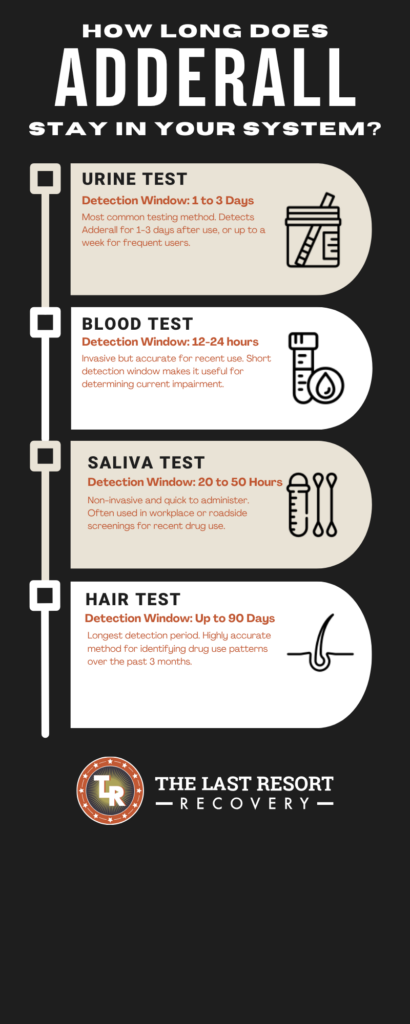
The detection time for Adderall varies depending on the type of drug test used:
Urine Tests: Adderall can be detected in urine for 1-3 days after last use for occasional users, and up to a week for heavy or chronic users.
Blood Tests: Adderall is detectable in blood for 12-24 hours after the last dose.
Saliva Tests: Detection window is typically 20-50 hours after last use.
Hair Tests: Adderall can be detected in hair follicles for up to 90 days, though hair tests are less commonly used for amphetamines.
What factors affect how long Adderall stays in your system?
Several factors influence Adderall detection time [5]:
- Dosage and frequency of use: Higher doses and regular use extend detection windows
- Individual metabolism: Age, weight, liver function, and overall health affect processing speed
- Hydration levels: Proper hydration can help eliminate the drug faster
- pH levels: Urine acidity significantly impacts elimination rates – people with lower urine pH eliminate Adderall faster, while higher pH slows elimination [3]
- Kidney and liver function: Impaired organ function slows drug clearance [5]
- Body composition: Higher body fat may store the drug longer
How is Adderall metabolized and eliminated?
Adderall is processed by the liver and eliminated through urine. About 20-25% of the drug is broken down into other compounds, while the rest leaves the body unchanged [3]. The drug has a half-life of approximately 10 hours [4].
Complete elimination from your system typically takes 2-3 days for occasional users. However, heavy or frequent users may need up to a week for the drug to be completely cleared from their system.
Can you speed up Adderall elimination from your system?
While time is the only guaranteed way to clear Adderall from your system, certain factors may support natural elimination:
- Stay hydrated: Drinking plenty of water supports kidney function
- Maintain a healthy diet: Proper nutrition supports liver metabolism
- Get adequate sleep: Rest helps your body’s natural recovery processes
- Avoid additional stimulants: Don’t compound the stress on your system
However, there are no proven methods to significantly accelerate the elimination process, and attempting to “flush” your system with excessive water or products can be dangerous.
What are the signs of Adderall addiction or dependence?
If you’re concerned about Adderall addiction, watch for these warning signs [7]:
- Taking higher doses than prescribed or for longer periods than intended
- Using Adderall without a prescription or taking someone else’s medication
- Inability to function without the medication or cut back despite wanting to
- Spending significant time obtaining, using, or recovering from Adderall
- Continuing use despite negative consequences to health, relationships, or responsibilities
- Neglecting work, school, or family obligations due to drug use
- Using Adderall in dangerous situations (like driving)
- Experiencing withdrawal symptoms when stopping (fatigue, depression, increased appetite)
- Building tolerance, requiring higher doses for the same effect
- Craving the medication or obsessive thoughts about using
What should you know about Adderall drug testing?
Drug tests for Adderall typically screen for amphetamines. If you have a valid prescription, inform the testing facility beforehand and provide documentation. However, if you’re using Adderall without a prescription or in higher doses than prescribed, it will show up as a positive result.
Standard drug panels don’t distinguish between different types of amphetamines, so Adderall use will trigger a positive result for amphetamines in general.
What are the risks and effects of Adderall misuse?
Adderall misuse can lead to serious health consequences and addiction. People may misuse Adderall by taking someone else’s prescription, buying counterfeit pills, taking higher doses than prescribed, or altering the medication (crushing, snorting, or injecting) to intensify effects [2].
Common reasons for misuse include:
- Students using it as a “study drug” to improve academic performance
- Adults taking it to enhance work performance or memory
- Recreational use for the stimulant effects
Risks of Adderall misuse include [6]:
- Cardiovascular problems (increased heart rate, blood pressure, risk of heart attack)
- Mental health issues (anxiety, paranoia, psychosis, anger)
- Unhealthy weight loss
- Sleep disorders and insomnia
- Increased risk of addiction and overdose
- Withdrawal symptoms when stopping
Men, All Hope Is Not Lost. Welcome To Your Last Resort.
If you’re struggling with Adderall addiction or stimulant misuse, you’re not alone. At The Last Resort Recovery Center, we’ve helped many men overcome substance use disorders and build lasting recovery.
Our comprehensive addiction treatment programs provide the medical support, therapy, and community you need to break free from stimulant dependence. From medical detox to residential treatment and ongoing support, we’re here to guide you through every step of recovery.
Don’t let Adderall control your life any longer. Contact The Last Resort Recovery Center today at (512) 750-6750 or reach out to our admissions team to learn how we can help you begin your journey to lasting recovery.
Your new life is waiting.
Sources
[1] U.S. Food and Drug Administration. (2007). Adderall® (dextroamphetamine saccharate, amphetamine aspartate, dextroamphetamine sulfate and amphetamine sulfate tablets). FDA Label Information.
[2] U.S. Food and Drug Administration. (n.d.). Prescription stimulant medications. https://www.fda.gov/drugs/information-drug-class/prescription-stimulant-medications
[3] Redwood Toxicology Laboratory. (n.d.). Amphetamines. Drug Information Resources. https://www.redwoodtoxicology.com/resources/drug_info/amphetamines
[4] Drugs.com. (n.d.). How long does Adderall stay in your system (urine drug test)? Medical Answers. https://www.drugs.com/medical-answers/long-adderall-stay-system-urine-drug-test-663004/
[5] Moeller, K. E., Kissack, J. C., Atayee, R. S., & Lee, K. C. (2017). Clinical Interpretation of Urine Drug Tests: What Clinicians Need to Know About Urine Drug Screens. Mayo Clinic proceedings, 92(5), 774–796. https://doi.org/10.1016/j.mayocp.2016.12.007
[6] Lakhan, S. E., & Kirchgessner, A. (2012). Prescription stimulants in individuals with and without attention deficit hyperactivity disorder: misuse, cognitive impact, and adverse effects. Brain and behavior, 2(5), 661–677. https://doi.org/10.1002/brb3.78
[7] American Psychiatric Association. (2013). Diagnostic and statistical manual of mental disorders (5th ed.). American Psychiatric Publishing.
[8] Detoxification and Substance Abuse Treatment [Internet]. Rockville (MD): Substance Abuse and Mental Health Services Administration (US); 2006. (Treatment Improvement Protocol (TIP) Series, No. 45.) Available from: https://www.ncbi.nlm.nih.gov/books/NBK64115/


Written by
Briana Sefcik
Director of Trauma and Family Wellness, MS, LCSW, CSATFrequently Asked Questions (FAQs)
No, there are no proven methods to significantly speed up Adderall elimination from your system. While staying hydrated, eating well, and getting rest support your body's natural processes, time is the only reliable way to clear the drug. Attempting to "flush" your system with excessive water or detox products can be dangerous and ineffective.
Yes, Adderall will show up as amphetamines on standard drug screening panels. If you have a valid prescription, inform the testing facility beforehand and provide documentation. However, most drug tests cannot distinguish between different types of amphetamines, so any amphetamine use will trigger a positive result.
Withdrawal symptoms typically begin within a few days of stopping Adderall and can last 3-4 weeks. The timeline varies based on how long you used the medication, your dosage, and individual factors. While physical symptoms may resolve within weeks, some people experience lingering effects like fatigue and mood changes that may require professional support to manage.

Ask us anything. We’ll tell you straight.
Our admissions team answers 24/7. No script, no pressure — just a conversation with someone who’s been where you are.
Free & confidential.
Or verify your insurance online